


Rising energy costs redesign global yarn manufacturing

Figure: Technology data provided by Rieter shows that modern compact spinning machines can save up to 18 per cent of electricity compared with conventional spinning systems. Courtesy: Collected
Rising energy costs redesign global yarn manufacturing
The international yarn sector has entered 2026 under significant cost pressure. Among the many challenges facing spinning mills, energy costs have emerged as one of the most critical strategic constraints. Rising electricity tariffs and unstable power supply in several textile-producing regions are steadily increasing conversion costs and reshaping the economics of yarn manufacturing.
Rising energy costs redesign global yarn manufacturing
Energy intensity of spinning operations
According to technical studies, producing 1 kilogram of ring-spun yarn typically requires about 3.5-3.6 kWh of electricity. While open-end spinning generally consumes about 2.4-2.6 kWh per kilogram, depending on machine efficiency and yarn count. This difference explains why energy costs are closely linked to spinning technology choices.
Ring spinning accounts for roughly 30 percent of total machine energy consumption, while air conditioning and humidity control systems can consume nearly 39 percent of total electricity used in a spinning facility.
Rising energy costs and industry competitiveness
Energy costs are a critical vulnerability for the global spinning sector, directly threatening thin profit margins and international competitiveness.
India: Energy accounts for 10–18% of production costs. An increase of ₹1 per unit in electricity tariffs can raise production costs by roughly ₹5 per kilogram, stifling export potential.
Pakistan & Türkiye: Mills face aggressive cost pressures, with electricity tariffs ranging from $0.16 to $0.18 per kWh. In Pakistan, energy costs can account for 35–40% of total operating expenses.
China: Despite superior infrastructure, even at more competitive rates of $0.066 per kWh, energy remains a decisive variable in cost efficiency.
Bangladesh: Energy costs represent 15–30% of total production expenses. A 33% surge in industrial gas prices (ranging from Tk 40–42/cubic meter for new industries and captive plants in early 2025) and a 32% supply shortfall have forced mills to rely on diesel-powered captive generators at costs 3 to 4 times higher than grid rates.
For spinning mills worldwide, energy isn't just an overhead—it is a primary determinant of market viability.
Technology investment and efficiency strategies
As a reaction to these pressures, large combined spinning groups are accelerating expenditures on recent machinery and electronic surveillance systems aimed at reducing energy use and increasing operating efficiency.
The development of spinning technology has already shown improvements. Technology data provided by Rieter shows that modern compact spinning machines can save up to 18 per cent of electricity compared with conventional spinning systems, amounting to a saving of about 12000.00 per annum in energy savings per spinning machine in a high-capacity spinning operation.
The technologies of automation are also enhancing productivity. Waste and defect reduction through automated material handling, process control, and digital quality inspection systems of yarns is achieved.
Strategic importance of energy management
Meanwhile, clothing brands and retailers worldwide are paying more attention to sustainability, supply chain transparency, and carbon footprint reduction.
The State of Fashion 2026 report, created by Business of Fashion in collaboration with McKinsey & Company, identified cost efficiency, supply chain resiliency, and operational transparency as the highest-priority priorities of fashion companies navigating further economic uncertainty.
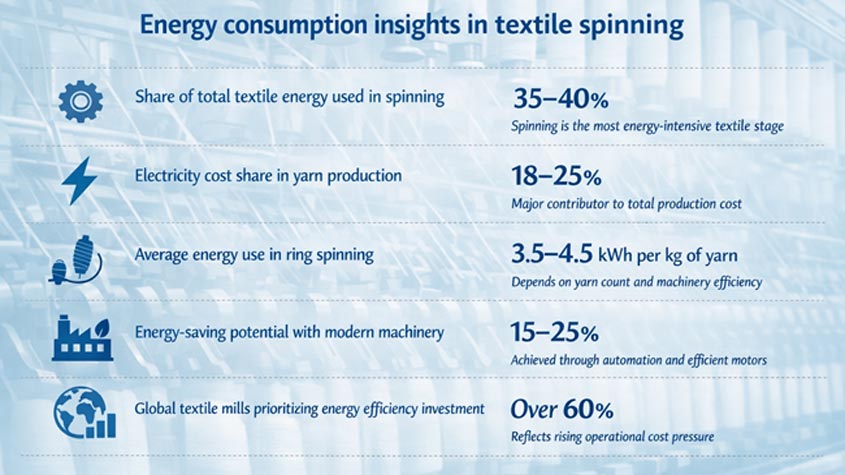
Analytical snapshot: Energy intensity in yarn production
Sources: Author Analysis based on data from International Energy Agency (IEA), International Textile Manufacturers Federation (ITMF), Textile Exchange, McKinsey & Company, The Business of Fashion
♦ References
.
.
Please Follow us on Social Media.
 |  |  |  |  |  |









| بازديد | تاريخ |
| ۴۳۰۴۴ | ۷/۱۳ |
| ۴۲۸۳۲ | ۷/۱۲ |
| ۳۴۷۱۶ | ۷/۱۱ |
| ۴۰۶۹۶ | ۷/۱۰ |
| ۲۵۶۶۸ | ۷/۹ |
| ۱۶۶۱۰ | ۷/۸ |
| ۷۵۳۴ | ۷/۷ |

