


Global Cotton Consumption Trending Up
Global Cotton Consumption Trending Up,
Production Trending Down for 2026/27 Season
Washington, DC — Global cotton consumption is projected to exceed production in the 2026/27 season as production, trade, and ending stocks decline modestly, according to the latest estimates from the International Cotton Advisory Committee (ICAC). The decline in production is largely attributed to reduced cotton area across most major producing countries.
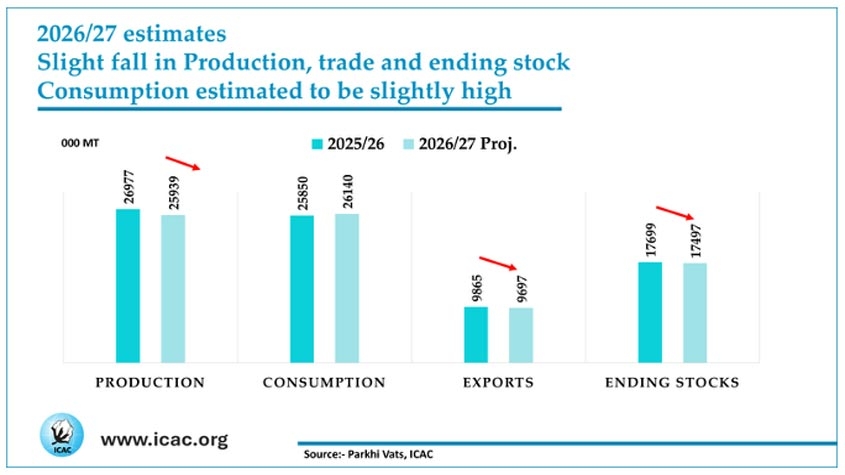
Global cotton production is projected at approximately 25.94 million tonnes in 2026/27, down 3.8% from 26.98 million tonnes in 2025/26. Consumption, meanwhile, is expected to increase by approximately 1.1%, from 25.85 million tonnes to 26.14 million tonnes.
The projections represent a notable shift in the global cotton balance. In 2025/26, production is estimated to exceed consumption by approximately 1.13 million tonnes. In 2026/27, that relationship is projected to reverse, with consumption exceeding production by approximately 201,000 tonnes.
Global Cotton Trade Projected to Ease
World cotton exports are projected to decline modestly in 2026/27, from approximately 9.87 million tonnes to 9.70 million tonnes, a decrease of about 1.7%.
The projected decline comes despite slightly higher global cotton consumption, highlighting a market in which overall mill use is expected to strengthen even as international trade volumes ease.
Ending Stocks Expected to Decline
Global ending stocks also are projected to decrease, from approximately 17.70 million tonnes in 2025/26 to 17.50 million tonnes in 2026/27, a decline of about 1.1%.
The combination of lower production, slightly higher consumption, and declining ending stocks points to a somewhat tighter global cotton balance in the coming season.
West Africa Cotton Sector Continues Long-Term Expansion
The October issue of Cotton This Month also includes an in-depth examination of the evolution of the cotton sector in West Africa, which has grown from a relatively small producer in the mid-20th century into one of the world's most significant sources of export-oriented cotton. Average annual production has risen from approximately 27,000 tonnes in the 1940s to more than 1 million tonnes in the 2020s, although much of that growth has resulted from expanded cotton area rather than higher yields.
For 2026/27, West African cotton production is projected to increase by approximately 6% to 960,000 tonnes, with nearly all of the region's output expected to be exported. The report examines challenges affecting further growth — including farm-gate prices, access to production inputs, pest pressure, and erratic weather — as well as opportunities to improve productivity and capture more value within the region.
The analysis highlights Côte d'Ivoire as an example of the potential for productivity gains. Cotton yields there increased from approximately 259 kg/ha in 2022/23 to 483 kg/ha in 2025/26, supported by improved pest management, better access to production inputs, and adaptations to changing rainfall patterns.
The report also identifies opportunities for the region to capture more value from cotton through expanded domestic processing, cotton by-products, biochar and Bokashi, and emerging export relationships. India increased imports from several West African origins in 2025/26, while expanded zero-tariff access to the Chinese market could create additional opportunities for African cotton exporters.
2026/27 Global Cotton Outlook
ICAC's latest estimates project:
Production: 25.94 million tonnes, down from 26.98 million tonnes
Consumption: 26.14 million tonnes, up from 25.85 million tonnes
Exports: 9.70 million tonnes, down from 9.87 million tonnes
Ending stocks: 17.50 million tonnes, down from 17.70 million tonnes
Taken together, the projections suggest relatively modest year-to-year changes in the major global indicators, but with an important shift in the relationship between supply and use as consumption moves above production.Price Projections
The ICAC Secretariat forecasts the 2026/27 Cotlook A Index price to range between 65 and 99 cents per pound, with a midpoint of 80 cents per pound.
The author of Cotton This Month is Parkhi Vats, Principal Statistician & Data Architect at ICAC.
The next issue of Cotton This Month will be released on November 2, 2026.Real-time statistical updates are available continuously via the ICAC Data Portal.
To subscribe to Cotton This Month, please click here.
About the International Cotton Advisory Committee (ICAC)
Formed in 1939, the ICAC is an association of cotton producing, consuming, trading, and investing countries. It acts as a catalyst for change by helping Member governments maintain a healthy world cotton economy; provides transparency to the world cotton market by serving as a clearinghouse for technical information on cotton production; and serves as a forum for discussing cotton issues of international significance. In addition, Members can take advantage of the ICAC's global network of cotton researchers, whose expertise covers the supply chain from farm to textile manufacturing, and have free access to its cutting-edge technologies like the voice-based app and virtual reality cotton training program. Committed to ensuring cotton's continued sustainability, the ICAC is the only intergovernmental commodity body covering cotton that is recognized by the United Nations.
♦ References
.
.
Please Follow us on Social Media.
 |  |  |  |  |  |










| بازديد | تاريخ |
| ۴۱۱۳۴ | ۷/۲۱ |
| ۱۰۲۲۵۲ | ۷/۲۰ |
| ۷۶۵۱۶ | ۷/۱۹ |
| ۸۳۳۴۶ | ۷/۱۸ |
| ۷۲۸۸۶ | ۷/۱۷ |
| ۸۰۱۴۰ | ۷/۱۶ |
| ۵۶۹۸۰ | ۷/۱۵ |

