


KARL MAYER to highlight CFRP pultrusion profiles at JEC World

KARL MAYER to highlight CFRP pultrusion profiles at JEC World
Presentation of the CETROVO at InnoTrans 2018 in Berlin (© CG Rail GmbH)
OBERTSHAUSEN, Germany — KARL MAYER Technical Textiles will showcase new applica-tion potential for multiaxial non-crimp fabrics combined with the pultrusion process at JEC World, March 10-12, in Hall 5, Booth C46.
Advancements in the pultrusion process enable cost-efficient production of complex CFRP multi-chamber profiles used in the CETROVO high-speed metro. The world's first carbon-intensive light-weight rail vehicle of this type is designed for speeds up to 140 kph. The high travel speeds create complex material stresses requiring multiaxial reinforcement.
The textile-reinforced CFRP pultrusion profiles, with wall thicknesses up to 25 mm, are engineered for multidimensional load cases. They are used in the highly stressed side walls of the CETROVO lightweight railcar body, where they transfer longitudinal forces up to 1,200 kN, absorb significant bending loads and contribute to a total weight reduction of about 30%.
"Weight reduction is particularly important for underground and suburban railways. Due to frequent stop-and-go operation, mass inertia plays a key role in energy consumption compared to air re-sistance,"said Prof. Dr.-Ing. Andreas Ulbricht, managing director of CG Rail GmbH.
Advanced process adds multiaxial reinforcement
CG Rail developed the CFRP profiles with partners in Dresden on behalf of Chinese rail vehicle manufacturer CRRC, adapting the pultrusion process for the application. The modifications enable production of multi-chamber profiles with multiaxial continuous fiber reinforcement in lengths ex-ceeding 20 meters.
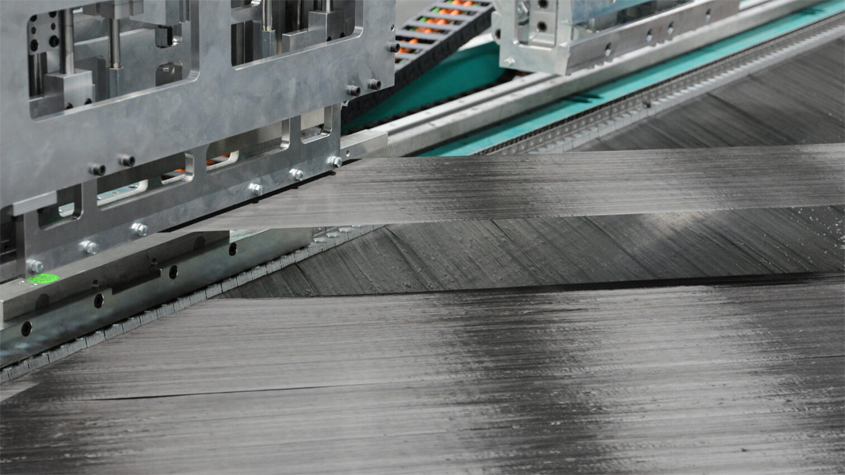
As additional reinforcement to conventional unidirectional longitudinal reinforcement, CG Rail pri-marily uses non-crimp fabrics produced on a COP MAX 5 multiaxial warp knitting machine from KARL MAYER. The system is designed for high productivity, flexibility and consistent material quality. Reinforcement fibers can be inserted at angles of plus or minus 20 degrees with a pitch of 1 degree.
"The reinforcing fibers are precisely integrated into multiaxial non-crimp fabrics without undulation, allowing us to fully exploit their mechanical performance potential. In addition, they are better fixed in the textile surface than in comparable woven fabrics," Ulbricht said.
COP_MAX_5.jpg
From laboratory to rail service
The first CFRP lightweight train debuted at InnoTrans 2018 in Berlin. An advanced prototype was highlighted at the World Transport Convention in 2024. Since January 2025, the CETROVO 1.0 has been in service on Line 1 in the Chinese port city of Qingdao, Shandong Province.
CG Rail is developing additional projects. CFRP pultrusion profiles offer new opportunities in the commercial vehicle sector, including ultra-light frame structures such as lattice frames for buses and semi-trailers. Weight savings compared to metal profiles typically range from 20% to 50%.
Kay_Burkhardt.jpg
Kay Burkhardt
KARL MAYER Technical Textiles is presenting various CFRP pultrusion profiles at JEC and plans to discuss additional applications with industry visitors.
"Our composite machines also produce bi- and multiaxial non-crimp glass fabrics that are further pro-cessed using the pultrusion method. The variety of materials and laying angles offers significant op-portunities for lightweight construction applications, which we look forward to discussing with visi-tors at JEC," said Kay Burkhardt, product manager at KARL MAYER Technical Textiles.
♦ References
►https://www.etextilecommunications.com
►https://www.karlmayer.com
.
.
Please Follow us on Social Media.
 |  |  |  |  |  |







| بازديد | تاريخ |
| ۱۲۰ | ۵/۶ |
| ۲۸۹۲ | ۵/۵ |
| ۲۰۰۶ | ۵/۴ |
| ۱۴۷۴ | ۵/۳ |
| ۸۲۸ | ۵/۲ |
| ۱۲۸۶ | ۵/۱ |
| ۱۸۲۲ | ۴/۳۱ |

