


Barmag FK6-1000 Draw Texturing Machine
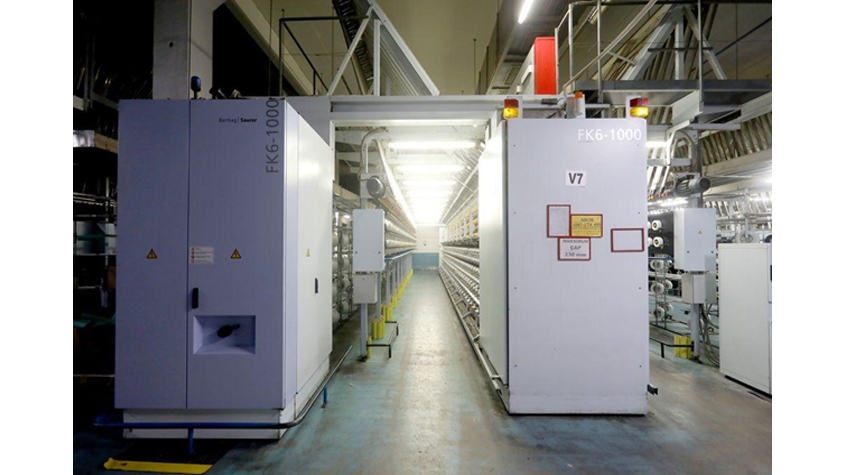
Technical Guide: Barmag FK6-1000 Draw Texturing Machine (DTY)
How the FK6 1000 Works (Process & Mechanical Principles)
The FK6 1000 operates on the false twist texturing principle, integrating drawing and texturing in a continuous line:
/ماشین-تکسچرایزینگ-Barmag-FK6-1000-(DTY).jpg)
Unwinding: POY packages are fed from a creel (stationary or rotary/Jumbo options) into the machine.
Pre heating / First Heater: Yarn passes through a primary heater (typically Dowtherm heated contact plates or HTI electrical high temperature heater) where it is heated to a temperature that allows molecular orientation and subsequent crimp setting. Heater lengths are typically 2.0–2.5 m depending on model variant.
Drawing: The yarn is drawn between godet rolls (feed rollers) to achieve the required elongation and orientation. Single drive godet units are used to ensure slip free transport and consistent tension.
False Twist Insertion: A friction based false twist unit (stack of ceramic/polymer discs) inserts twist upstream of the cooling zone. The twist is false because it is cancelled downstream, but the heat set helical crimp remains. Disc stacks can be configured for a wide denier range and different twist levels.
Cooling: A cooling rail/plate (approx. 1.1–2.1 m depending on configuration) solidifies the crimp structure before the twist is removed.
Second Heater (Heat Set): A secondary heater (typically ~1.46 m) further stabilizes the crimp and reducesTorque/shrinkage.
Take up (ATT): The finished DTY is wound using Oerlikon Barmag's Advanced Take up Technology (ATT), which provides precise package build, controlled traverse, and high doffing efficiency.
The process is thermomechanical: heat plasticizes the filament, mechanical drawing orients the polymer chains, twist creates bulk, and cooling/second heating fixes the structure.
/جدول-مشخصات-تکسچرایزینگ-Barmag-FK6-1000-(DTY)_2jpg.jpg)
2.1 Spindle and Friction Unit Data
The false twist spindle is one of the critical components.
Typical characteristics:
High rotational speed friction discs
Ceramic guides
Precision bearings
Replaceable friction elements
A technical reference for Barmag FK6 machines reports friction spindle operating speeds in the range of approximately:
7,000–9,000 rpm
depending on application and configuration
3. Processable Fibers and Applications
3.1 Fibers
The FK6-1000 is mainly designed for:
Polyester (PET)
Examples:
PET POY → PET DTY
Apparel yarns
Industrial filament yarns
Polyamide (Nylon)
Examples:
Nylon 6
Nylon 6.6
The FK6-1000 PA versions were specifically developed for polyamide texturing applications.
3.2 End Uses of FK6-1000 Produced DTY
DTY produced on FK6-1000 machines is used in:
Apparel
Sportswear
Activewear
Knitted fabrics
Hosiery
Home Textiles
Curtains
Upholstery fabrics
Decorative textiles
Industrial Applications
Technical fabrics
Automotive textiles
Specialty filament applications
Texturing improves:
Soft hand
Bulk
Elastic recovery
Thermal insulation characteristics
4. Production Capacity and Productivity
Production capacity depends on:
Number of positions
Yarn denier
Draw ratio
Machine speed
Polymer type
Operator settings
5. Critical Operational Notes for Textile Engineers
5.1 Yarn Quality Control Parameters
Important process parameters:
Yarn Tension
Incorrect tension causes:
Uneven crimp
Package defects
Variable dye uptake
Modernized FK6 systems may use online tension monitoring systems such as Unitens.
5.2 Heater Control
Engineers must monitor:
Heater temperature stability
Heater cleanliness
Yarn contact condition
Residence time
Temperature settings depend on:
Polymer type
POY specification
Yarn count
Required DTY characteristics
5.3 Friction Unit Maintenance
The friction unit is a critical maintenance area.
Regular checks:
Disc wear
Bearing condition
Alignment
Yarn path cleanliness
Vibration
Bearing failures in Barmag friction spindle systems have been documented as a critical maintenance issue requiring monitoring.
5.4 Yarn Guide and Ceramic Parts
Inspect:
Ceramic guides
Yarn contact surfaces
Wear marks
Damaged guides can cause:
Filament breaks
Hairiness
Tension variation
5.5 Drawing Adjustment
Correct adjustment of:
Feed roller speed
Delivery roller speed
Draw ratio
is essential because it controls:
Elongation
Tenacity
Crimp properties
/ماشین-تکسچرایزینگ-Barmag-FK6-1000-(DTY)_12jpg.jpg)
For polyester DTY 150/48 (150 dtex, 48 filaments) on a Barmag FK6-1000, the normal operating speed depends on:
Machine generation (FK6-1000 M, V, PA, etc.)
Friction unit type
POY quality (e.g., 150/48 POY)
Required DTY properties (tenacity, elongation, crimp)
Heater configuration
Draw ratio
For a standard 150/48 PET DTY application, typical industrial speeds are:
For FK6-1000 / 150-48 DTY / 600 m/min / 240 spindles / 90% efficiency:2.8 tons/day
Production Comparison Example
Polyester DTY 150/48
Assumptions:
Yarn: 150 dtex / 48 filaments
Speed: 650 m/min
Efficiency: 90%
Running time: 24 hours/day
/ماشین-تکسچرایزینگ-Barmag-FK6-1000-(DTY)_11jpg.jpg)
Engineering Note
The 288-position FK6-1000 does not necessarily run faster than the 240-position machine. The productivity increase comes mainly from:
More texturing positions
More parallel yarn ends
Similar process speed
Oerlikon Barmag documented extension solutions allowing existing 216- and 240-position FK6-1000 machines to be expanded up to 288 positions by adding sections and related drives/supply systems.
(Engineering Note)
For purchasing evaluation of a used FK6-1000, the most important confirmation points are:
Exact model: FK6-1000 M / V / PA
Year of manufacture
Number of sections
Number of working positions
Heater type (single/double heater)
Friction unit condition
Unitens/tension control availability
Actual yarn trial with 150/48 PET POY → DTY
/ماشین-تکسچرایزینگ-Barmag-FK6-1000-(DTY)_7jpg.jpg)
/ماشین-تکسچرایزینگ-Barmag-FK6-1000-(DTY)_9jpg.jpg)
/ماشین-تکسچرایزینگ-Barmag-FK6-1000-(DTY)_10jpg.jpg)
♦ References
►https://www.barmag.com
► https://www.barmag.com
.
.
Please Follow us on Social Media.
 |  |  |  |  |  |









| بازديد | تاريخ |
| ۲۱۷۶ | ۵/۲۹ |
| ۵۷۸۴ | ۵/۲۸ |
| ۵۹۱۶ | ۵/۲۷ |
| ۶۲۴۲ | ۵/۲۶ |
| ۷۱۷۴ | ۵/۲۵ |
| ۸۳۰۶ | ۵/۲۴ |
| ۷۲۶۶ | ۵/۲۳ |

