


Türkiyes denim sector targets luxury speed and sustainability
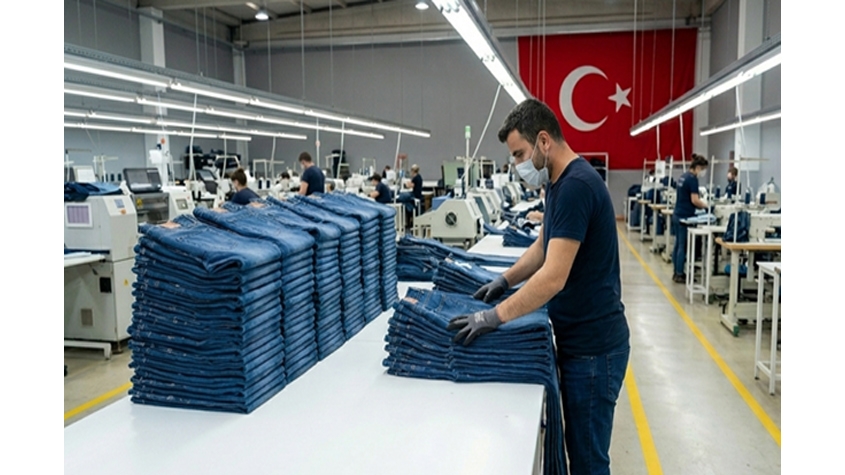
Türkiye's denim sector targets luxury speed and sustainability
Türkiye's apparel and denim industry is rapidly transforming into a premium sourcing hub as global buyers increasingly prioritize sustainability, speed, flexibility, transparency, and regulatory compliance over low-cost production.
Figure:Europe remains Türkiye's largest denim export market, accounting for nearly 68% of total shipments, according to the İHKİB strategic roadmap.
According to the Istanbul Apparel Exporters' Association (İHKİB), Turkish manufacturers are now aggressively investing in hyper-automated smart factories, circular production systems, and low-impact denim technologies to strengthen long-term competitiveness in the global market.
The shift is already visible in export performance. Data from the Turkish Exporters Assembly (TİM) shows Türkiye's denim exports reached nearly $1.35 billion in 2026, rising from approximately $1.18 billion in 2025. Industry sources attribute the growth to strong European demand for premium near-shore denim products with higher environmental traceability and faster lead times.
Europe remains Türkiye's largest denim export market, accounting for nearly 68% of total shipments, according to the İHKİB strategic roadmap.
Industry experts say Türkiye can no longer compete with Asian sourcing destinations based on labor cost advantages alone. Instead, the country is positioning itself as a technology-driven and sustainability-focused manufacturing base capable of delivering premium quality products with shorter production cycles.
One of the biggest transformations is taking place in denim finishing operations. Turkish manufacturers are rapidly replacing traditional stone washing and chemical-intensive processes with ozone, laser, and digitally automated finishing technologies.
Advanced systems from global technology providers such as Jeanologia and Tonello are now widely used across Turkish denim factories to reduce water and chemical consumption while improving production precision and consistency.
At the same time, local machinery manufacturers, including VAV Technology, Marmara Machine, and Bulut Makina, are supplying advanced domestically engineered systems tailored for Türkiye's high-volume denim sector.
VAV Technology's robotic laser systems enable highly precise distress applications, while Marmara Machine's ozone generators support chemical-free bleaching processes. Bulut Makina's nano bubble air mist technologies significantly reduce water and chemical use during finishing operations.
According to the International Textile Manufacturers Federation and Turkish textile industry associations, nearly 80% of Turkish denim factories had integrated ozone and laser technologies into production operations by 2025. Industry estimates suggest these technologies can reduce water consumption by up to 90% and chemical discharge by nearly 95%. Several advanced facilities have reportedly reduced water usage from almost 100 liters per kilogram of garment production to below 10 liters.
Artificial intelligence and automation are also emerging as major competitive advantages. AI-powered fabric inspection systems are increasingly being deployed across weaving and finishing lines to detect defects in real time, reduce waste, and improve operational efficiency. Automated laser robots and robotic material handling systems are helping factories improve productivity while reducing labor-intensive processes.
Circular manufacturing is becoming another key pillar of Türkiye's denim strategy. Leading manufacturers, including ISKO and Mavi Jeans, are investing heavily in recycled cotton yarns, garment recycling systems, and post-consumer textile waste processing to meet growing global demand for circular textiles.
Several advanced Turkish denim mills are also operating Zero Liquid Discharge systems capable of recycling up to 99% of process water while minimizing hazardous chemical discharge.
Industry analysts believe Türkiye is steadily strengthening its position as a premium denim sourcing destination built on sustainability, innovation, speed, transparency, and compliance-driven manufacturing rather than low-cost competition alone.
♦ References
►https://www.textiletoday.com
.
.
Please Follow us on Social Media.
 |  |  |  |  |  |








| بازديد | تاريخ |
| ۴۸۰ | ۶/۲۲ |
| ۴۶۴۰ | ۶/۲۱ |
| ۴۹۰۰ | ۶/۲۰ |
| ۴۱۶۲ | ۶/۱۹ |
| ۶۰۷۰ | ۶/۱۸ |
| ۸۲۳۲ | ۶/۱۷ |
| ۲۷۸۴۴ | ۶/۱۶ |

