


The power of aramids at COP26

The power of aramids at COP26
Teijinconex neo resists temperatures of up to 400°C without burning or melting.
 Envision Racings driver suit designed by OMP Racing.
Teijin high-performance materials are represnting performance properties that will never be achievable with natural fibre or biopolymer alternatives at this weeks COP26 in Glasgow.
The worlds first electric two-seater Formula One race car, which incorporates Teijins Tenax carbon fibre, is on display in the COP26 Blue Zone. The vehicle was developed by the Envision Racing Team in partnership with Johnson Matthey, a leader in sustainable technologies. Tenax, which combines strength, high modulus elasticity and low density, assures top mechanical performance even in high heat, design freedom and driver safety.
Envision Racings driver suit, designed by OMP Racing and incorporating Teijins meta-aramid Teijinconex neo, is also on display in the Green Zone. The outer layer of the garment consists of an ultra-light fabric made with Teijinconex neo to resist temperatures of up to 400°C without burning or melting. Teijinconex neo is produced in line with all chemical industry environmental standards, including REACH.
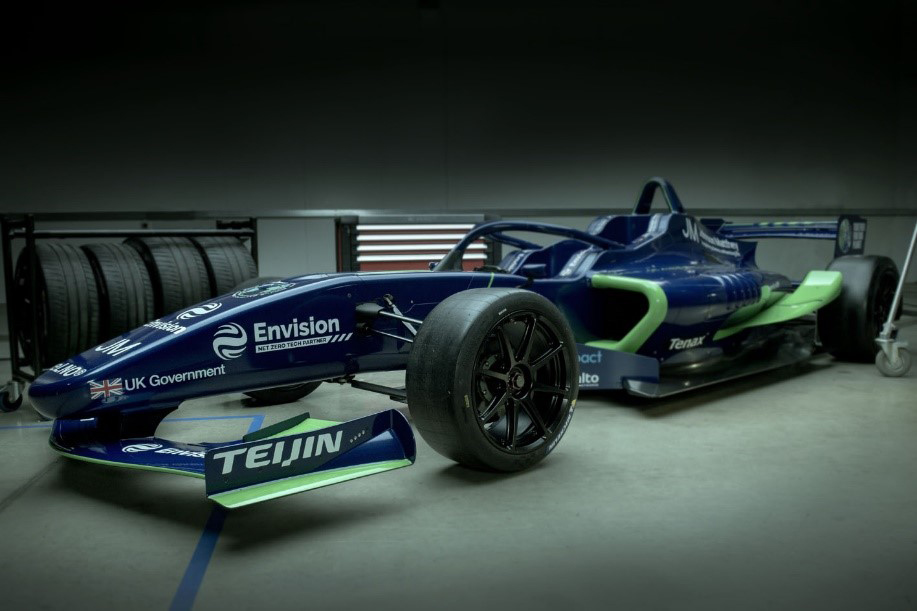
The worlds first electric two-seater Formula One race car developed by Envision Racing Team in partnership with Johnson Matthey.
Teijin has established long-term goals for internal net-zero emissions by 2050. Its targets include reducing internal CO2 emissions by 30% and two-thirds of total supply-chain emissions by 15% as of 2030 compared to 2018 levels.
Teijins Tenax carbon fibers and intermediate materials are being applied in the renewable energy field, including large wind-power turbine blades, advanced aircraft wings and hydrogen tanks. It is also used to achieve increased production speed and safety, extended design freedom and customer targets for increased sustainability.
Teijins aramid business, which has been mechanically recycling end-of-life para-aramid Twaron products into pulp for over 20 years, is now exploring new recycling possibilities for other aramid products. It is using, for example, para-aramid yarn in recycling trials by adding recycled yarn in the spinning process. It is also working to create high-quality fibre by regenerating pre and post-consumer meta-aramid-based materials from protective textiles.
Teijin aims to create a circular value chain by minimising both waste and the use of virgin materials. To achieve this, it is working to reduce carbon emissions, set new standards for recycling all aramids and create transparent material streams.
www.teijin.com
https://www.innovationintextiles.com/fibres-yarns-fabrics/the-power-of-aramids-at-cop26/
https://garmentsmerchandising.com/protective-clothing-uses-applications/








| بازديد | تاريخ |
| ۴۶۸ | ۶/۲۲ |
| ۴۶۴۰ | ۶/۲۱ |
| ۴۹۰۰ | ۶/۲۰ |
| ۴۱۶۲ | ۶/۱۹ |
| ۶۰۷۰ | ۶/۱۸ |
| ۸۲۳۲ | ۶/۱۷ |
| ۲۷۸۴۴ | ۶/۱۶ |

