


ELiAR Smart Sensors bring real-time control to textile dyeing
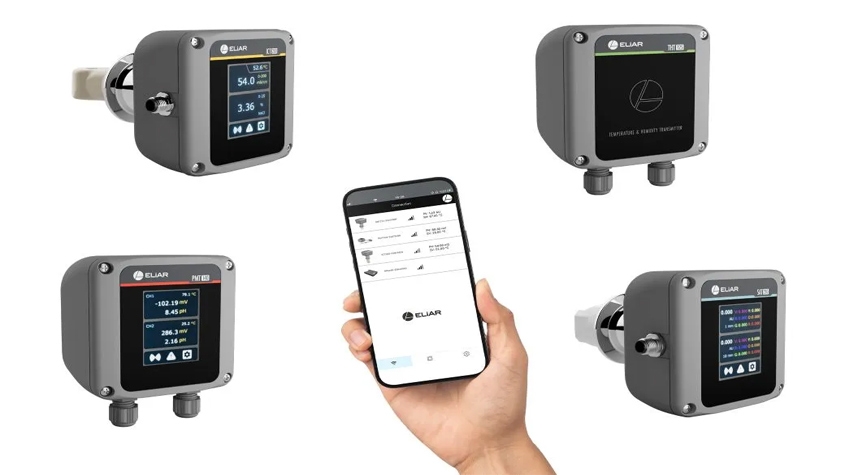
ELiAR Smart Sensors bring real-time control to textile dyeing
The textile industry is entering a new era in which sustainability, productivity and process intelligence must work together. As dye houses face growing pressure to reduce water, energy and chemical consumption while maintaining consistent quality, the ability to monitor and control processes in real time is becoming increasingly important.
This is the foundation of ELiAR's Smart Sensor technology.
Designed to transform conventional dyeing processes into intelligent, data-driven operations, ELiAR Smart Sensors continuously monitor critical process parameters and communicate directly with the dyeing machine's control system. By turning real-time process data into actionable decisions, they help manufacturers improve dyeing efficiency while reducing water, energy, chemicals, processing time and operator dependency.
The result is Smart Dyeing: a more efficient, measurable and sustainable approach to textile processing.
ICT200: Real-time conductivity monitoring
The ICT200 Inductive Conductivity Transmitter provides continuous monitoring of conductivity, allowing the system to track changes related to chemical concentration in the dye bath in real time.
Its non-contact, electrodeless measurement technology enables reliable process monitoring with minimal maintenance requirements. By continuously transmitting actual process data to the machine controller, ICT200 provides operators with live visibility of critical dyeing parameters and supports more accurate and repeatable process control.
Instead of relying solely on predefined recipe values, manufacturers can monitor what is actually happening inside the dye bath and respond accordingly.
PMT140: Precise pH control, connected to the process
pH is one of the most critical parameters affecting shade, dyeing performance and reproducibility. ELiAR's PMT140 pH Sensor provides rapid measurement of the dye bath, with readings available in approximately 20 seconds.
The sensor does more than simply monitor pH. When the measured value differs from the target, the system can command the relevant chemical dispenser to dose the required acid or alkali.
This creates a closed-loop process:
Measure → Compare → Dose → Verify.
By reducing unnecessary manual intervention and improving dosing accuracy, PMT140 helps maintain the required process conditions while supporting consistent dyeing results.
SAT210: Intelligent dye exhaustion and rinsing control
The SAT210 Spectrophotometric Absorbance Transmitter takes process monitoring one step further by continuously tracking dye exhaustion in the bath.
By monitoring the colour exhaustion curve, SAT210 can identify when dye absorption has reached a stable condition. The dyeing machine can then automatically recognise that the process stage has been completed and proceed to the next step—without relying solely on fixed process times.
The same principle can be applied during rinsing.
SAT210 monitors the residual colour and particles transferred from the fabric into the bath, helping determine whether additional washing is actually required. When the required rinsing condition has been achieved, unnecessary extra washes can be avoided.
This can translate directly into lower water consumption, shorter cycle times and reduced energy usage.
From Smart Sensors to Smart Dyeing
The key advantage of ELiAR Smart Sensors is their integration with the dyeing machine's control architecture.
The sensors communicate continuously with the machine controllers, allowing measured values and process conditions to be monitored directly through the dyeing machine interface or through ELiAR's centralised monitoring and management software.
This transforms sensors from standalone measuring instruments into an integral part of the automated dyeing process.
The machine does not simply follow a recipe—it can respond to the actual condition of the process.
Efficiency that supports sustainability
By making process conditions visible and enabling intelligent responses, ELiAR Smart Sensors can help textile manufacturers reduce unnecessary consumption and improve overall production efficiency.
Their potential benefits include:
Lower water consumption through optimised rinsing
Reduced energy consumption by minimising unnecessary heating and process holding
More efficient chemical use through controlled dosing
Shorter processing times through condition-based process transitions
Reduced operator dependency through automated monitoring and intervention
Improved process consistency and reduced risk of unnecessary reprocessing
These operational improvements also create a strong economic case. With relatively low investment requirements and measurable savings in daily production, Smart Sensor systems have the potential to pay back their investment through the efficiencies they generate.
Beyond textile dyeing
Although developed with textile processing in mind, ELiAR Smart Sensors are not limited to dyeing machines. Their measurement and monitoring capabilities can also be applied in areas such as water treatment, chemical processing and other industrial processes where real-time process control is essential.
For ELiAR, Smart Dyeing is not simply about adding sensors to a machine. It is about creating a new approach to textile production—one where data leads to decisions, decisions lead to action, and action leads to measurable efficiency.
ELiAR Smart Sensors: Measure smarter. Control better. Dye more sustainably.
Note: The headline, insights, and image of this press release may have been refined by the Fibre2Fashion staff; the rest of the content remains unchanged.
♦ References
►https://www.fibre2fashion.com
.
.
Please Follow us on Social Media.
 |  |  |  |  |  |







| بازديد | تاريخ |
| ۳۱۶۲ | ۷/۲ |
| ۳۰۵۴ | ۷/۱ |
| ۵۰۰۶ | ۶/۳۱ |
| ۱۰۴۶۸ | ۶/۳۰ |
| ۱۴۴۸۴ | ۶/۲۹ |
| ۴۷۷۴ | ۶/۲۸ |
| ۴۲۰۸ | ۶/۲۷ |

